
« Human-made » labeled artist
Because, for me, artistic creation will remain solely made by human intelligence!

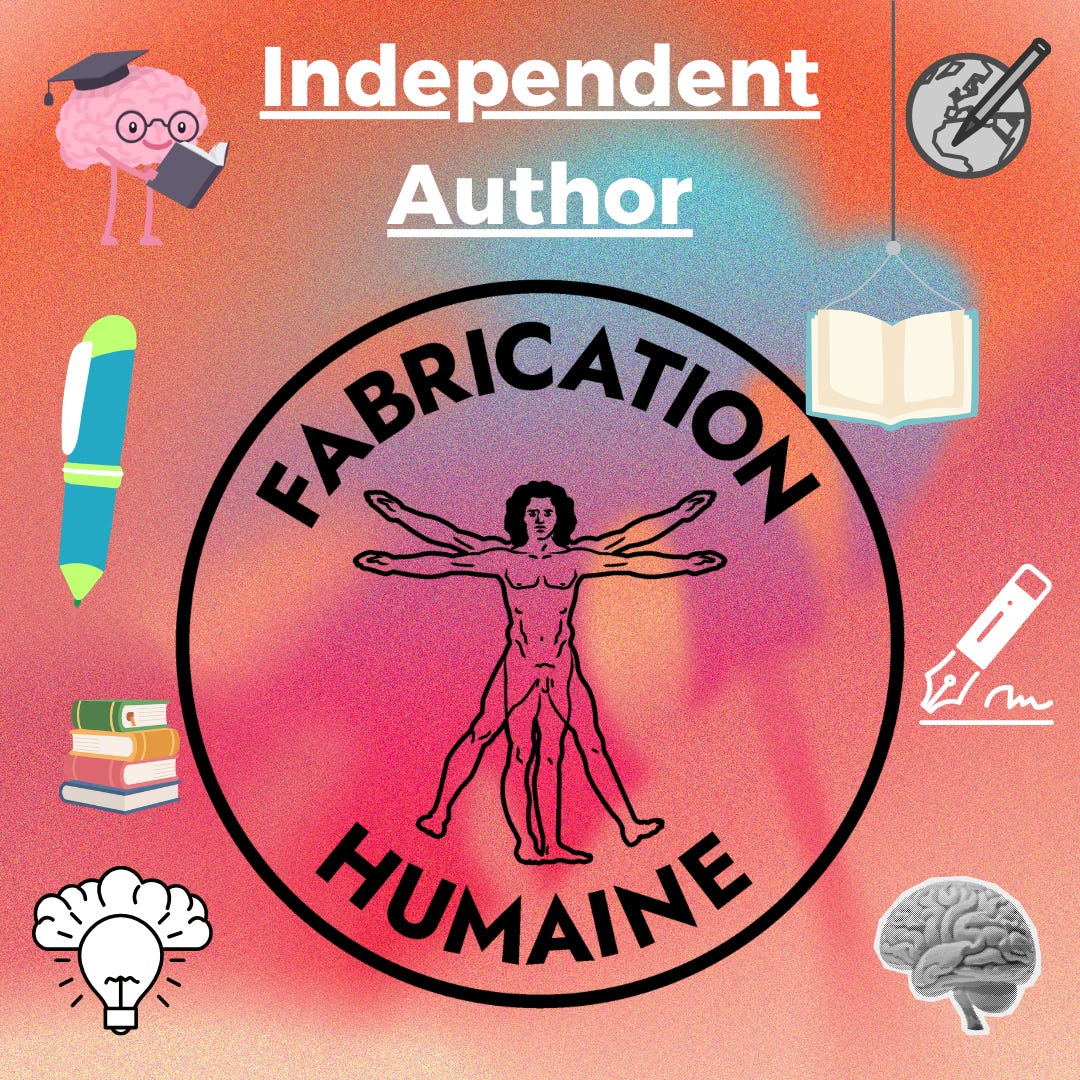
If you actively follow me on social media, which I do not doubt (;-)), you could notice some small changes in the descriptions on my profiles.
Indeed, for several months now, I have held the label entitled “Human Made Label.” This label was created by French artists and creatives who advocate an artistic creation, whatever it is, making use of the brain and human intelligence only. Without outside technological help.
By choosing to join this label, it means that I am an artist who does her work thanks only to her brain and not with the help of artificial intelligence. Basically, I practice my art and create thanks to my personal and human intelligence. I possess the skills and, if not, work to acquire them by developing my brain daily. And this involves reading, reading, reading, analysis, and reflection!
I advise you to reread or read my article on AI, published in February 2025 on AI:
Then my other articles on the need to make our brains work daily so as not to lose in cognitive matters.
In promoting this label, we are not rejecting artificial intelligence. On the contrary, I think it is very useful in fields such as medicine or science. This is beneficial for the human being because it makes it possible to heal him, thus to save him, cure him or even advance science with a view to improving living conditions for living beings. And that is what AI must do: always allow human beings to live better.
Myself, I am lucky to be able to use AI daily through an improvement of my own body. Indeed, I am hard of hearing and this health problem requires a hearing correction, as visually impaired people (myopic, etc.) require pairs of glasses to improve their eyesight. My hearing aids compensate for my hearing loss so that I can hear (almost) correctly. Science has made many advances in this field, notably thanks to AI.
The latest generation of hearing aids that I have just acquired now has an AI that allows me to withstand noisy environments better than before. This improvement is very pleasant for me because it causes less fatigue at the end of the day and also less tinnitus in the evening. So I am grateful to the AI used for science and technology that allows humans to compensate for a lack created by nature and which, for example, has made me hard of hearing.
However, for more than a year, and the rise of AI applications, I have been able to observe changes among the authors I meet at book fairs. Some do not hesitate to use AI to develop their book covers and it shows.
I create and develop my covers by myself without any help, other than traditional desktop publishing software. And the day when you, my reader friends, will be very numerous and that the sales of my books will allow me to obtain fixed monthly income, I will call on professional graphic designers to develop my covers in order to free myself from this charge, and more because I value human work. But let’s leave this topic aside because it is not relevant at the moment.
For some time now, the authors have admitted to me that they use AI to proofread their texts and take into account the improvements it proposes. This is where a malaise settles in me. These authors state that they modify their own writings and use the proposals of AI. So they admit to having taken over sentences written by someone else, in this case, the AI. Therefore, a question arises: can we consider that these authors really wrote these texts? Texts that their own human brains have not been able to produce since modified and rewritten by an artificial intelligence.
As for me, the answer I give is a categorical ‘NO’. Again, do not hesitate to read my many Substack posts about artistic creation. ‘No’, because admittedly, these so called ‘authors’ gave an idea, but it was written and materialized by AI. Their human intelligence was unable to produce a text, a sentence that is correctly written. They did not work enough on their own intellectual abilities to develop themselves a writing worthy of the name.
From the moment a text has been rewritten by another, AI and so on, is the original author the author of that text or just the idea? So is he an author or just a proponent of ideas?
Not without humor but also with a hint of bitterness in my speech and my heart, I recommend every time to these ‘author’ colleagues to put aside the AI and follow an artisanal technique used by Gustave Flaubert, a great French author of the 19th century whom I encourage you to discover or rediscover.
This author used a technique that I practice myself to a lesser extent, of course. Indeed, first he could write and rewrite a sentence for days, then he put his writings to the test of the ‘gueuloir’. He screamed his texts to make sure they sounded right. And it works. Because it’s exactly what I do for each of my writings, including this newsletter.
Of course, I do not shout them out. My neighbors would be very surprised and probably worried to hear me scream in the evenings and on weekends! But I say them out loud, sometimes in front of my only audience: my cat, who looked at me with round eyes, surely wondering where this crazy woman who was talking to herself standing and pacing the room in front of her text or her computer was coming from! With intonations if it is a dialogue, as in the theater.
As an author, a person who writes texts, this practice is extraordinary. It allows you to refine the accuracy of sentences and paragraphs, one after another. It highlights linguistic errors and gives the brain a better mise en abyme of its own writing. This technique offers the human brain what AI will never give: the ability to spot errors itself and correct them with its intellectual knowledge.
In other words, the brain progresses by and through itself alone. And this is important in order to preserve it from degenerative diseases that notably impair memory. Again, as I said in previous articles, the more the brain works daily, the less it will be prone to degenerative diseases like Alzheimer’s or other dementias.
So, to write and be ‘corrected by AI’, at the risk of no longer being able to write in ten years because of a degenerative brain disease, or to write by oneself thanks to our human brain and know that it will work properly until the age of one hundred. And that, therefore, we will write until our last breath. My choice is made!
I value the work produced by the human brain because I believe it will always be more qualitative, especially if we train the brain daily. It is important to keep and maintain our intellectual knowledge so as not to lose our cognitive abilities early. The more the brain trains, the more it will remain active and able to create and invent, whatever the age. AI will never replace this organ in our skull, and it must not replace it. Without AI, we live very well; without a brain, we die, literally and figuratively!
An author who deliberately chooses to use AI to ‘correct’ his writings does not have sufficient intellectual capacity to create a text. In that case, why does he do this job?
Is a heart surgeon who does not know how the heart and arteries, among other things, able to do his job? No. Is an airplane pilot who has no knowledge of aircraft engineering and control a good pilot? No. Both are charlatans. An author must not deviate from this rule. An author who does not know how to write is a charlatan. Like every profession, he must be trained to learn how to write and develop his imagination. Otherwise, he will be nothing but a scammer.
Does appropriating a rewritten text through AI make us the true author of the work? I think you’ve guessed the answer I’m giving to this question! ;-)
And you, as readers, do you want to read books whose authors have been corrected by AI and are therefore no longer the authors?
If you wish to read books produced by human intelligence, click here.